No mode cookie
Jonny Quest Tazos, Menko Card
Scans and content © 2008 & 2011 by Craig Fuqua
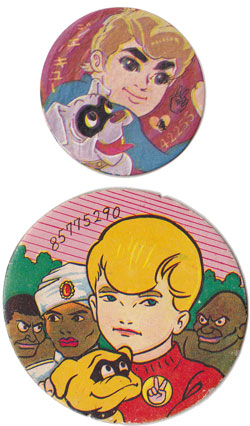
These are Jonny Quest "Menko" cards from Japan. The small one is about 2-1/8
inches across, the one with Jonny and Hadji is 3-1/16 inches, and the one with Jonny and Dr. Zin is 2-3/4 inches.
The age is unknown, but they're probably from the late 1960s or early 1970s.
Menko cards are thick pieces of cardboard with images on one or both sides. Children
would throw their card next to an opponent's card to try to flip it with the air
current.
On these cards, the small hand images that look like peace signs actually represent
scissors for a rock-paper-scissors menko game, Gu-Choki-Pa. The numbers on the cards,
42255 on the small card and 85775290, indicate the cards could also be used for
"Fighting Numbers" menko games. For more information, see WikiHow's article on the different ways to play menko.
Menko card games may date back 200 years or more. For more information on the history
of menko, see Wikipedia's
article on Menko and one menko collector's recounting of the history on SumoFanMag.com.
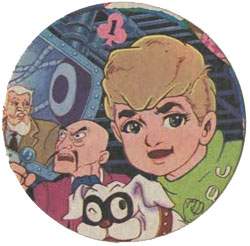
Here are some "tazos" from Peru. Like pogs, each is about 1.5 inches in diameter
and were probably stuck inside the caps on milk or juice bottles as collectible
premiums. The source of the images is unknown, so they may have been original drawings
for the tazos. Notice Dr. Quest is called "Prof.," Bandit is "Fito" (perhaps the
Peruvian version of Fido) and "Race" Bannon is called by his first name, Roger.
These trading cards are from Argentina, where they may have been called "figuritas."
They're the same size as the tazos above and look like they're made of the same
cardstock, so I'm guessing their source is the same. Hadji is called, "Haji," which
was the spelling in a lot of the licensing material given out by Hanna-Barbera,
while Bandit is "Bandido." Again, "Race" is called "Roger." The seller said they
were made in 1969 and that the artist was Josè Clemens.
Jonny Quest and distinctive likenesses © Hanna-Barbera.
All other images, image designs and other image work on this site are
© ClassicJQ.com, © Hanna-Barbera or as
noted. Text content is © ClassicJQ.com, except where noted otherwise,
and may not be shared or re-published without the consent of the author.
This is strictly a fan-based site, and is in no way
affiliated with or approved by Hanna-Barbera or any other
organizations, unless specifically indicated otherwise.